



When was the last time you wrote something by hand? For how long can you write before your hand starts cramping?
If you’re 10 and 65+ (and don’t have any medical reason to struggle with writing), you should not get cramps when writing by hand, which brings me to my point.
More and more I have noticed that many people have no idea how to write by hand with a healthy hold of the pen, and a higher number of people are starting to accept the fact that having bad handwriting is OK. Spoiler alert: it is not.
For thousands of years handwriting was not just a way to write messages: it was an art. In the Shang Dynasty in China (1700–1100 BCE) characters were carved onto oracle bones as a way to communicate with ancestors. Thousands of years later, in the 12th century, the western world created gothic calligraphy because of the need to mix speed and beauty. This style of text can still be seen in the strokes modern calligraphers use today.
Writing in cursive is not only great for memory consolidation, but also for strengthening neural pathways and fine motor skills over time, which can lead to better cognition later in life.
Growing up, I did not have nice handwriting. In fact, my “a’s” were turned the opposite way, and my sentences looked like they were constantly falling off cliffs. Eventually, my preparatory school made me do writing exercises over and over and over until the letter’s shape, size, thickness, and whatever else they thought necessary was acceptable/readable.
But, I wanted to continue practicing my writing. I wanted to be the girl in class everyone asked to write the headers for their notebooks. Plus, I was six when I started journaling, albeit not well, but by the time I was eight, I wanted to master the art of beautiful handwriting
So, I studied, watched videos, read books, and I bought all sorts of pens with my allowance. It became my hobby. From the Palmer Method to Spencerian Script, I tried it all. And I started to question why the act of writing wasn’t being taken as seriously as it used to.
As a society, we have been increasingly focused on efficiency rather than beauty. And this extends to all aspects of our lives. Corsets became bras, stained glass became paneled windows, pilasters became support beams hidden within walls, and cursive became print.
Who do we have to blame for this? Is it human nature to let intricacies of art slip through our fingers and be replaced by faster, but cheaper—and therefore uglier—alternatives? At least in my opinion: yes, it is our fault.
Here’s the bright side, we can change this. We can decide to bring back the whimsical complexity of our world. And the brighter side is that many already have. But if you have not yet, one simple way to bring back the small beautiful details that make everyday life a little more interesting is by changing the way you write and allowing yourself to embody an art style that is rapidly declining.
Holding the Pen:
For a beginner, I recommend sticking with a gel pen. Ballpoint works, but I’m personally not a fan because ballpoint pens tend to skip, fade, and dry-out more often. My favorite pen is the Uni-Ball Signo DX in 0.38. There are many different colors to choose from, and the pens are super affordable.
Once you have found a pen you are comfortable with, the next step is to perfect the hold. Use your thumb and index finger to pinch the front end of the pen above the conical shape with the tip. Next use your middle finger to join together with your thumb under the pen, increasing the support. Now rest your ring and pinky finger against your middle finger—these fingers do not touch the pen. If you turn the pen to face yourself, you should have a “tripod-pod” grip.
Stay with me now. Grab a piece of paper and try to write your name. If this is not the way you usually grip the pen, it might look strange. And you might be thinking: “There is no way that this can actually make a difference.” But I’m not done yet.
Lift your forearm off of the table. Keep in mind that your support should be solely in your pinky and ringfinger. If it’s easier, move the paper ninety degrees so that it is horizontal against the surface, but you should still be able to write in a straight line. With your new grip in hand, write your name without moving your wrist, but instead by moving your arm. Keep the movement focused on your shoulder and forearm.
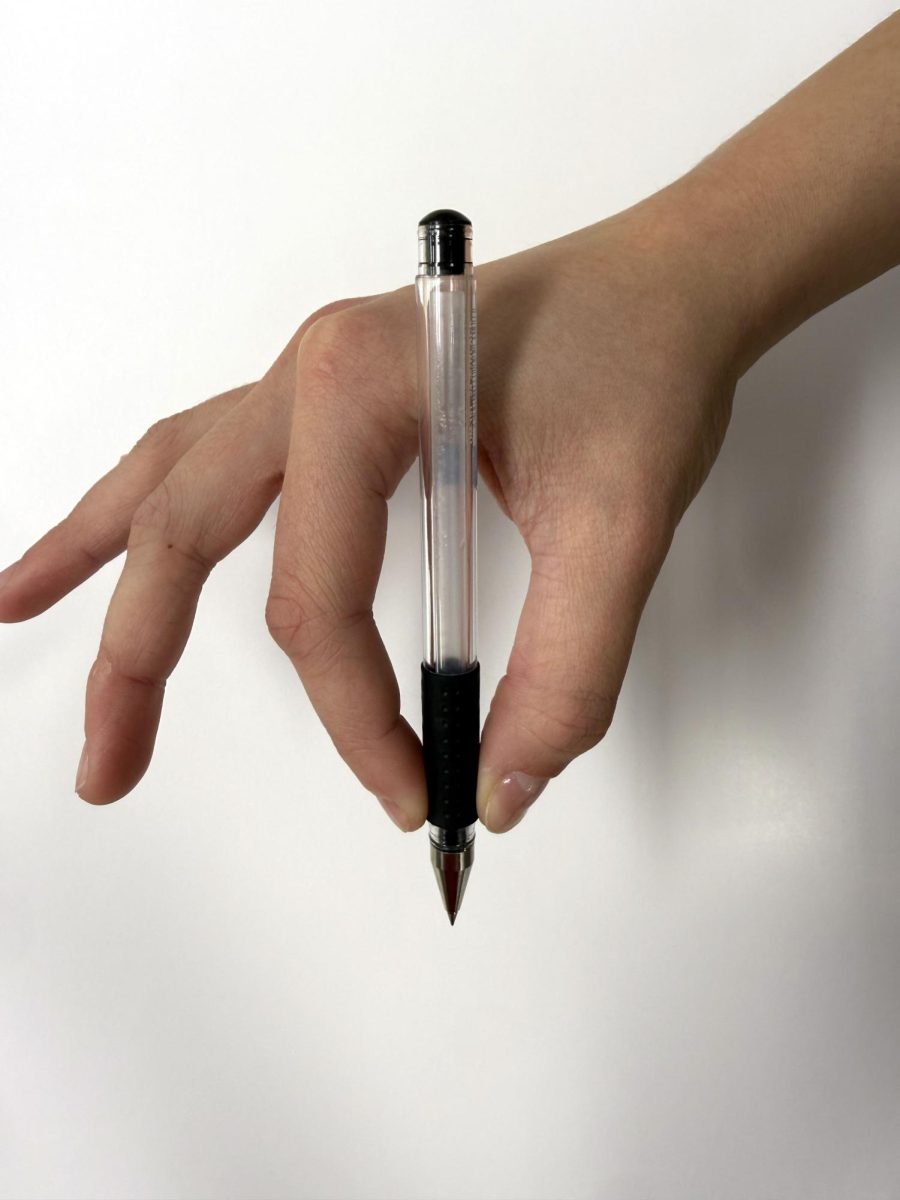
Did your name look any better? Maybe not, and that is totally normal. But practice makes perfect. So if you have found a new determination to make your handwriting better—and healthier—keep writing the alphabet over and over. Start with script and then try to work on your cursive. Make sure your grip stays light and never press down hard on the paper. That’s how cramping starts, and we want to avoid that.
With this technique, calligraphers were able to write whole books with consistent, beautiful handwriting that didn’t leave them with carpal tunnel in their wrists by the end of the day.
So the next time you are writing by hand, take a moment to notice how you are holding your pen. If you’d like, change the way you write, and over time know that you will keep your wrist healthy. Also keep in mind that you are continuing an art form that has been alive for centuries.



Nathan • Mar 4, 2026 at 7:43 pm
She’s done it again 🔥